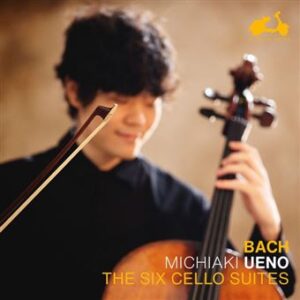
Michiaki Ueno – Bach Cello Suites
La Dolce Volta LDV115.6
Suites 2, 3, and 6 were recorded between November 24–26, 2021, while Suites 1, 4, and 5 were captured from May 3–7, 2022. The album was released in October 2022, with all sessions taking place at Evangelische Kirche Honrath in Lohmar. Ueno performs on a cello crafted by P.A. Testore in 1758.
About the Cellist.
Michiaki Ueno’s official biography opens with: “Born in Paraguay in 1995, he spent his childhood in Spain. After moving back to Japan, Ueno made his debut as a soloist at the prestigious Suntory Hall at just eleven years old, performing the Lalo Cello Concerto.” A genuine prodigy in a shrinking world! Ueno was 26 at the time of these recordings—though Richard Narroway still holds the record for the youngest artist to release the Bach Suites. Ueno has collected a number of awards, including the 2024 Beethoven Ring, a prize decided by 1,700 members of the Beethovenfest Bonn organisation. He earned this for his interpretation of Beethoven’s A major Sonata No. 3—a process that seems about as democratic as these things get. Aside from the Bach, his discography so far includes “Origin,” a recording of mostly solo Japanese works. Among his teachers is Wispelwey.
The liner notes for this release feature an insightful interview with Ueno, who comes across as straightforward and genuine in his thoughts on Bach. His approach is instinctive, guided by what we know about Baroque performance practice but not bound by it. Refreshingly, the record label has made the booklet available online—a practice that should be standard.
Ueno puts it this way: “The most important thing is to have a clear idea of the story you’re telling. I confess that, here too, instinct takes precedence over ‘the rule’. The key point is to preserve the unity, the narrative tension within each suite, and keep to the same message.” It’s a promising outlook.
The Recording.
Ueno plays with a modern setup and bow, using wound gut strings. This combination gives the cello sound a bit of rasp and a woody character, with fewer overtones but more clarity in the upper range. As is common in contemporary recordings, the microphone placement is fairly close, capturing some breath sounds but barely any fingerboard noise. The overall sound is open and full of ambiance—arguably too much. At times, the acoustics of the church venue (high ceilings, minimal pillars) come through a little more than is ideal, producing a swirling echo that, once noticed, can be hard to ignore. While this environment may be wonderful for the performer, on repeated listening it can tire the ear, though it does encourage Ueno to play with a relaxed, natural tone.
The Music.
These impressions apply to the full set: Ueno delivers a polished, confident interpretation without unexpected twists. What stands out is the maturity of his playing—thoughtful, controlled, and easy on the listener. The Suites unfold smoothly and musically, if a bit predictably, with phrasing that’s both sensitive and expressive. There’s variety in the dynamics and timbre, allowing Ueno to shift effortlessly from gentle to assertive passages.
Ornamentation is tastefully subtle, and slight variations in repeats keep things interesting. On a technical level, everything is in place: articulation is precise, even in the most demanding moments of the Sixth Suite.
The rhythm has a gentle swing, and Ueno succeeds in maintaining both the unity and the narrative drive of each Suite. It’s easy to imagine his communicative style working beautifully in a live setting.
Final Thoughts.
This is an ideal recording for anyone new to the Bach Cello Suites. Ueno’s readings are straightforward and free of distractions—never dull, thanks to his innate musicality. That’s no faint praise.
If there’s a downside, it’s the church’s persistent reverberation, and perhaps a slight wish for more youthful fire from such a young artist. Still, Ueno’s depth and composure more than compensate.
—Charles