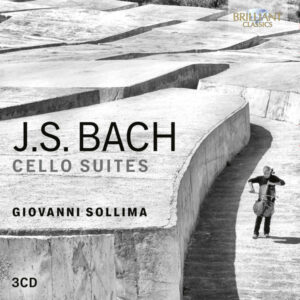
Giovanni Sollima – Bach Cello Suites
Brilliant Classics CD 96390 (also available digitally)
Released 2024; recorded March 2021 at Chiesa S.S. del Rosario, Bagnara Calabra, Italy
For Suite No. 6, Sollima performs on a five-string piccolo cello, switching to his 1679 Francesco Ruggieri instrument for the remaining suites.
—
Introduction
This three-disc set is excellent value, especially given its current discounted price. Discs one and two feature the complete six Bach Cello Suites, while the third offers an intriguing selection of related pieces—including a version of Steve Hackett’s “Horizons” (Hackett being best known as Genesis’s guitarist).
About the Cellist
Giovanni Sollima seems perpetually restless—someone whose creative powers only sharpened during the forced downtime of the pandemic. That pause gave him the chance to focus on these Bach Suites, and the time was clearly well spent.
Sollima is a true polymath, known for collaborations with musicians like Yo-Yo Ma. For a rundown of his career, a glance at his Wikipedia page is probably the most efficient route. You can also get a sense of his creative energy on his personal website.
From the liner notes, we learn Sollima pushes boundaries with a mix of ancient, electric, and even unconventional instruments, performing everywhere from the Sahara desert to underwater—and yes, sometimes on an ice cello.
His heart, though, seems most attached to Baroque cello. On this recording, he sticks rigorously to the Anna Magdalena manuscript, preserving its quirks, lapses, and unexpected sonorities. He tunes his cello to A=415 Hz and uses (wherever possible) plain gut strings.
The Recording
Sonically, this is what you’d hope for from a modern production: full, vivid, and brash! thanks to the gut strings’ rich overtones. Fingerboard clatter and breathing are barely there, and the chapel’s acoustics offer resonance without turning the whole thing into an echo chamber.
The Music
At first, Sollima’s reading doesn’t sound dramatically different from other Baroque-informed performances. But with the score in hand, his individual choices start to stand out.
Gut strings and period technique anchor this as a Baroque interpretation. His commitment to the Anna Magdalena version makes it a historically informed one, too. Still, Sollima takes plenty of adventurous detours. Ornamentation is bold and improvisational, perhaps most strikingly in the Second Suite’s Minuet. Here, the da Capo return acquires a reprise of the last few bars—a neat surprise.
His use of tempo variations lifts the music into an almost Romantic space, but never at the expense of musical direction. The Courantes zip along briskly—maybe too much so, as the articulation verges on muddled at times. The combination of speed, dexterity, and ornamentation can blur the lines between phrases, but it’s done with panache and keeps the ear engaged.
The gut strings and Sollima’s precision shine in the Prelude of the Third Suite, bringing out its harmonic shifts. The Fourth Suite, mostly played at a fast rate (except for the Sarabande), sometimes feels rushed, though the Sarabandes themselves provide genuine moments of poise and reflection.
The Fifth Suite takes a more subdued approach. While the Courante and Gigue lack their usual bite, the Allemande benefits from deliberate phrasing and structure. Oddly, the whole suite feels a bit restrained—maybe a deliberate interpretive choice, evoking mourning or contemplation, perhaps influenced by the idea of the Crucifixion as in Steven Isserlis’s readings. The booklet offers no clues here.
For Suite Six, Sollima brings out his piccolo cello. The instrument stands apart from the Ruggieri—less robust in the lower range, but nimble and resonant in higher passages. The Sarabande especially benefits from the piccolo’s ability to clarify double-stopped voices, and the result is both distinctive and moving. Gavotte II, with its hurdy-gurdy flavour, is a highlight—Sollima is audibly expressive, maybe even dancing as he plays, and throws in an extra repeat for good measure.
Conclusion
There’s a huge amount to appreciate here, even with some unevenness in pacing and dynamics. The inventiveness of Sollima’s ornamentation and his playful attitude offer constant interest. He uses repeats to introduce fresh ornamentation and occasionally draws out a raspy, buzzing tone by playing close to the bridge.
Sollima’s infectious joy in Bach’s music is clear, inviting listeners to share in the ride. Add to that a generously filled third disc of Bach-inspired extras and an affordable price, and you have an easy recommendation.
Charles.