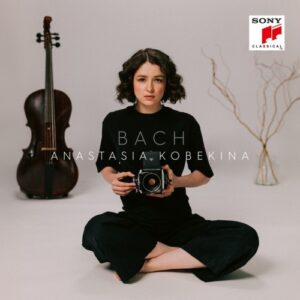
Anastasia Kobekina’s Bach Cello Suites, released on Sony Music Classical (catalogue G010005564113K), is available both as a CD and across all the usual download and streaming platforms.
For this recording, Kobekina plays her regular Stradivarius cello from 1698, known as the “De Kermadec-Blass,” as well as the 1717 “Bonamy Dobree Suggia.”
The album was recorded in the Theatre Saint Bonnet, Bourges, France, from January 19 to 25, 2025.
About the Artist
At 31, Anastasia Kobekina stands out as a young cellist with an impressively international profile. Born in Russia, she gained wide recognition, notably securing third prize at the 2019 Tchaikovsky Competition. Recently signed to Sony, Kobekina now enjoys major promotional backing. This has helped her appear twice at the 2025 BBC Proms — including a memorable all-night program featuring several of Bach’s Suites. She’s also discussed this Bach release on a recent Gramophone podcast.
Kobekina’s year in music was also the subject of a four-part documentary, Now or Never (see more here). In addition, there’s a growing collection of performance videos on YouTube. Clearly, expectations are high for this already accomplished musician.
On the Recording
Kobekina provides thoughtful introductory notes for the Suites as a whole, though not for each piece individually. She characterises the Suites’ character as a blend of Apollonian clarity and Dionysian passion. It’s the wildness that stands out most in her interpretation.
I first listened to this album on Tidal, streaming at 24bit/96Hz — and even with streaming’s inherent limitations, the quality is superb. The sound feels simultaneously spacious and intimate. The cello’s earthy resonance is captured as well as the shimmering brightness of gut strings in the upper register. Less positively, you’ll occasionally hear fingerboard taps and other incidental noises. They don’t bother me, but some listeners might notice them more. The small French auditorium, reportedly equipped with an adjacent pool for the musicians to cool off, turns out to be a terrific acoustic choice. Much preferable, I think, to the chapels and churches usually favoured for Bach.
After listening to the CD on my NAIM player, my impressions were only reinforced.
Musical Approach
While this album is promoted as a Baroque project, Kobekina’s take draws equally on modern sensibilities. She plays on gut strings, dispenses with the endpin, and uses a lighter bow, as mentioned in the Gramophone interview. Yet her approach often slips into a more contemporary style, with sweeping legato phrasing and less of the sharply articulated rhythm associated with period practice (think Watkins or Tunnicliffe). Her dynamics and tempo ebb and flow in ways that feel spontaneous rather than predictable. Listening requires full attention — the performance is full of unexpected twists and sudden transitions.
Kobekina’s technical assurance burns through each movement. She never sounds like she’s on the edge, but there’s still plenty of adrenaline, especially in the quicker passages.
Observations on Specific Movements
First Suite.
If you expect the opening Prelude to flow smoothly in the manner of Pierre Fournier, prepare to have your expectations unsettled. No two bars receive the same dynamic or tempo. While the overall sense of movement just about hangs together, the focus shifts to the microscopic detail within each measure. Sometimes at the cost of the bigger picture.
In the first Courante, a striking effect emerges — select notes seem almost omitted, leaving only a series of musical “stepping stones” marking out the phrase. Most performers highlight these key notes by subtle emphasis; Kobekina, in quick passages especially, makes the effect quite stark, though it seems intentionally done. Otherwise, her articulation in fast movements is spotless.
Third Suite.
The third Prelude begins assertively, then wanders before launching into a brilliant string-crossing episode.
Fourth Suite.
In the fourth Prelude, the music skips forward with playful pauses — it’s like walking an easily distracted dog. About ten bars from the end, Kobekina suddenly delivers a discordant note where an E-flat would normally be. It’s jarring, but so decisively played that it seems deliberate.
Fifth Suite.
The fifth Prelude stands out for its bold but controlled introduction, and the fugue that follows benefits from Kobekina’s keen analytical mind. Each entry of the subject gets clear and individual treatment.
The fifth Suite’s Sarabande may be the recording’s most provocative moment. It begins with an otherworldly sound, but soon becomes fractured by a pronounced emphasis on the third beat. Sometimes the movement is broken into detached notes, then shifts back to sustained phrases. The dynamics vary widely — it’s as though Kobekina wants to try every known approach to this movement in one take. Switching styles within repeat sections works, but varying every couple bars might prove distracting. That said, the Sarabandes elsewhere are a highlight, showcasing resonant chords and double stops without disruptive interpretive tics.
Sixth Suite.
The Sixth Suite is delivered impressively, particularly a soaring high passage in the middle section that dazzles with its clarity and pitch.
The closing Gigue of the Sixth Suite wraps things up with an athletic, energetic flourish.
Final Thoughts
It’s hard to sum up this recording in a sentence or two. There’s much that’s inventive and impressive, but also moments that might catch a listener off guard. Looking at the whole, it feels like an incredibly analytical reading, with Kobekina illuminating the subtle inner workings of the music — there’s never a trace of dullness here. Yet, for all the intellect and insight, it left me a little emotionally distanced. Maybe further listens will change that. This is a Bach recording for listeners who already know and love the Suites, but it might not be the best introduction for a newcomer.
Charles.
Anastasia Kobekina Bach (Sony Classical 19802954682) Recorded 2025
Kobekina has received training in different traditions, initially at the Moscow Conservatory, but subsequently in Berlin, Paris, and Frankfurt. She was 3rd prize winner at the 2019 International Tchaikovsky Competition, and her profile has continued to rise since then.
The tools of the trade used in this recording are 2 Stradivari and a Piccolo Cello. For Suites 1-3 she used her regular “De Kermadec Blass”, 1698, and for Suites 4 and 5 the “Bonamy Dobree Suggia”1717. The Piccolo Cello used for Suite 6 is by Mittenwald, 1800. She also used 5 Baroque bows, and a total of 13 gut strings for the set!
The recording quality I think is overall very good, with some immediacy, and is probably relatively close miked (with inevitable noises off, about more anon). Soundstage is not overly wide, but the French Theatre utilised does allow for some limited reverb when called upon. As Kobekina’s approach errs to the chamber recital side not a large and powerful stadium sound, I think the venue is well chosen. The set has 2 pages of Kobekina’s notes on how she sees the Suites, and her approach to them.
I was amused to find the cover of the set proclaims simply that we are to be offered “Bach”. No mention of the Cello Suites within. Does this slightly pretentious approach reflect into the performance in the set itself. Well, I would unhelpfully answer here yes, and no! Time to move onto the Suites….
In my critical listening sessions, I wrote down well over 2 A4 sides of tiny writing which, truth be told, even I am having trouble now deciphering! However, they would in any event generate too long a review. So, rather than attempt to go into the minutiae of the set, I decided a helicopter view would prove a more productive approach. What I have looked for in her approach, are patterns, styles, impressions, and consistent factors in her performance. I will try and draw these out below.
Firstly, an elephant in the room, is the prevalent finger tapping, and other noises off, throughout. This became particularly marked in the 6th Suite, where Charles, as a cellist himself, surmised they may have had to adjust the record level, as the Piccolo Cello is less bold than the standard cellos. Frankly, this final Suite had a veritable cavalcade of fireworks popping, reminiscent at times of a New Year’s Day welcome! So obviously from all the above, the set is an also ran for me you might think. Well, no it isn’t….
Right from the off (the Suites are played in numerical order) I realised I was in the presence of an act of recreation. There seemed no way I could attach them to a particular style of performance. Their prevailing lighter sound than usual would suggest a baroque performance, and her past studies certainly allowed for that, but her phrasings were much more imaginative rather than conforming to tradition. There was a noticeable flair that might tend to the romantic, but the actual sound produced didn’t have that emotional heft so common to such performances. In fact, I would describe her approach to the Suites as largely analytical, and yet not in any way impeding their impact.
I felt throughout that Kobekina was building her performance by focussing on individual phrases without being too focussed on the overall structure of the movements. She was absolutely prepared to use lashings of hesitations within the movements, and yet they never broke the overall flow. I tried to find a touchstone from the many versions I have reviewed over time. The nearest I could find is my highly valued 3rd Yo Yo Ma version, which I found in its gentle confiding approach to be deeply spiritual, and it drew me in. Kobekina does push out a little more it’s true, which had its own rewards, but both versions I think are, in their own ways, idiosyncratic, and uniquely individual.
Kobekina’s pacing of the Suites is generally on the moderate to slow side, but the Courante of the 2nd Suite, positively explodes out of the blocks, and the quicksilver pace and power displayed dispel any notions of limited technique.
Mostly though there is a lightness to her playing style, truthfully with the results proving that sometimes less is more. I found myself thinking that she had made things harder for herself, as if she had played at a greater, more common volume, it could have covered up some of the finger tapping!
The cellist may have had the performance mapped out in her mind beforehand, but it’s not the impression I had. Rather than a studio performance it felt more like a live one-off version, never to sound the same again. I also pictured her is swaying along with the music, as I was gently rocking along, and as for her movement endings they were often of a gossamer delicacy I found most appealing. There was a fair bit of sniffing within to, making me think she may have had a cold at the time of recording.
I have a personal penchant for the slower movements particularly the Sarabandes, and of course the astonishing 6th Suite Allemande, which was here a true highlight where my notes stated, “There is so much going on here that, for me, it’s a real thing of beauty”. She does use ornamentation here (and not uncommon elsewhere), but overall, her usage seems reasonably tasteful, if in odd movements it might take a little time to adjust to. Returning to those slow movements, I was surprised how moved I was by the (in the past for me) not particularly remarkable 2nd Suite Sarabande. It was mournful and moving, but not too slow, and conjured impressions of Purcell’s masterful lament for Dido “When I am Laid To Earth”
Some may find the 6th Suite an anticlimax. For sure, her first movement lacks the constant melodic stream of many versions, and her final Gigue homecoming is not as positively framed as some. Yet, I think she is consistent with her approach to recreating phrase by phrase displayed throughout the set.
This is not a “Man (or Woman) For All Seasons” set. Some will love Kobekina’s adventurous, clean slate, approach to the Suites, whilst others will be irritated by the lack of an obvious direction and structure throughout, copious hesitations in phrasing, and personal idiosyncrasies. This has already been reflected in reviews I have come across, where 2 major music journals have given it short shrift, but a national newspaper gave a favourable review! As for me, I am just glad to have spent time in her artistic presence, and this recreative act. Frankly, if I could convince Charles to convert my Favourite Five into a Super Six, this would make my cut in the pantheon. I suspect that might be a forlorn hope, but I dare to dream!
Mark.