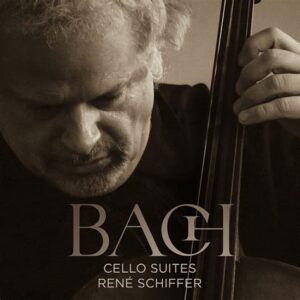
René Schiffer Bach Cello Suites (Avie AV2704) Recorded 2019-22
René Schiffer would seem to be somewhat of a musical polymath. He is adept not just on the standard cello, but historical cello, bass viol, bass violin, violoncello piccolo, and G Violone. Schiffer has composed several dozen classical style works, including 2 ‘Bach Suites’ (a 7th and the Kronstadter Partita). Having trained principally under Anner Bylsma and Jaap ter Linden his affinity for historical performance is very well established, and he has played with many highly reputed period ensembles, especially as principal cello with Apollo’s Fire since its inception. The latter has yielded a Grammy award in its time. It’s no surprise that he has also taught in various Colleges Music departments primarily in the USA. Apparently, Schiffer is also very good at declaiming epic poetry….
Given the above it perhaps won’t be a surprise that Schiffer’s extensive notes accompanying this set are fascinating and wide ranging. In the process he touches on such diverse musicians as Puccini, Mahler, Casals, Mozart, Telemann, Beethoven, and even Linda Ronstadt, Neil Young, Whitney Houston plus the country singer Chris Stapleton! The discourse includes a very good attempt at buttoning down through reasoned argument what performing practice in Bach’s time might have entailed, why he has added his own embellishments to the Suites and why he speculates the Suites might symbolise the story of Christ or even the creation of the Universe! He seems very satisfied to note that on the latter point Stephen Isserlis has expressed some affinity to the view as well.
Turning to Schiffer’s choice of instruments, for Suites 1-4 he uses a Benoit Fleury, 1768. However, for both the 5th and 6th Suites he uses a late 18th Century Violoncello Piccolo with a 5th String added. Using this in the 5th Suite is I believe a first in my experience. Naturally, he does provide reasons for his choice, and an honest appraisal of the strengths and weaknesses of his approach. On the latter aspect he does offer for those preferring the standard cello’s bigger sound a recommendation to hear the version by Steuart Pincombe. To show that Schiffer is not slavish to period practice he also adopted concert pitch of a’=440 because he wanted the set to be more universal than a historical reproduction and felt it suited his cello choices sound better.
All the above detail, far beyond my normal background notes, is offered to show that the booklet alone contains enough information to almost make the release recommendable aside form the music itself. However, I must now turn to the latter to show whether the main course matched the starter….
As always before writing a review, I played the set twice. The first time was to acclimatise to its general impressions. This was followed by a listen where I would focus more intently and take (usually copious) notes, and so it proved on this occasion, although my reference to the notes will, in this instance, be fairly broad. On first hearing I found the set rather impressed me and made me think of David Watkin’s much feted period version, against which it seemed to hold up very well. In fact, the clean and vibrant playing was at least Watkin’s equal and, I felt, probably surpassed it for technical competence.
On the more focussed second listen some doubts regarding my initial perceptions did appear though. The recordings were made in a Cleveland Heights Episcopal Church which had plenty of air around the performer but also tended because of reverb to mask some of the harmonics and overtones that can often be detected in performances of the set. I still found it acceptable being habitually open to a wide choice of venues, but some (including my fellow reviewer Charles when I played him a sample) may not be so tolerant. One unfortunate side effect though was the bass notes tended to boom which was noticeable right from the 1st Suite Prelude, which was commenced at quite a lick….
In fact, the 1st Suite was despatched in under 19 minutes. The quick pacing was
Rather generally evident throughout the set. It made me feel (rather tongue in cheek) that perhaps the producer had limited studio time available, or Mr. Schiffer was running late for the last bus. Of course, as the Suites were set down on 3 different years and over at least a 3 year time period, this wouldn’t be the case but was presumably a conscious choice by the cellist. To be fair, the quick pacing wasn’t a complete constant. For example, Schiffer took 7 minutes over Bach’s profound 6th Suite Allemande.
Throughout the Suites it is not uncommon to find a call and echo approach to the initial melody and its repeat. However, I didn’t a great deal of variety in Schiffer’s dynamics with the full-on sound becoming a bit wearing over time. Again, to be fair, there were exceptions within the performance including, for example, the 6th Suite Prelude, where call and response was much in evidence. What he did provide was his own ornamentations, not an uncommon approach in period performances. I didn’t find these in any way intrusive, with the exception of the 6th Suite, where in the Gavottes, Schiffer inserts a significant elaboration of his own before the return of the 1st Gavotte (frankly a rather nice one too) which I felt imbalanced the Structure a little.
As regards his choices of cello, particularly in the 5th Suite, I think the cellist accurately stated the trade-offs in his notes, being an “added vibrancy” but with some loss of “deep sonority”. Whether that is worthwhile is ultimately a matter of personal taste.
If all the above taken in the round suggests I am damning with faint praise, I should add that there is no doubt Schiffer is very well informed on the Suites and performance practice and applies his perceptions throughout and, for instance is well able to interpret the different styles of the movements as he chooses with some lightness too, when he considers it appropriate. His technical skills are clearly first class too, and the playing is very clean, with very little evidence of noises off. However, by the end I wasn’t completely sold on the set and admit that, for historical performances, I would still favour David Watkin’s searching and life affirming set, which left me breathless – in a good way!
In summary then, Schiffer’s interpretation carries a cautious recommendation only from me, whilst acknowledging others may find it much more favourable. I would certainly recommend it for the booklet notes though, well worth anyone’s time in reading! Ultimately, and acknowledging a 3rd listen to the set might crystallise my overall perceptions better, I felt I am much more likely to reach for Watkin than Schiffer when seeking my next period performance nourishment from the Suites.
Mark.