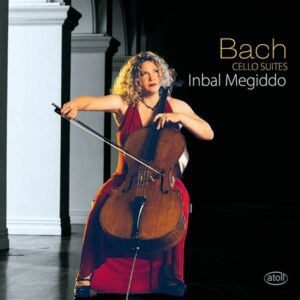
Inbal Megiddo Bach Cello Suites Atoll ACD 233 Available only for download or streaming upto 24bit 96Hz.
Released October 2025.
Cello played made by Fiorini in 1923
Recorded at Stella Maris recording studios Seatoun Wellington New Zealand, during 2021 and 2022
The cellist.
Inbal Megiddo is a cellist whose musical education appears to have moved from Israel, to America and encompassed private lessons from Rostropovich. Several sources and interviews emphasise the role of Aldo Parisot at Yale university in her career as teacher and mentor. For a time Megiddo was assistant to Parisot at Yale. The earlier part of her career seems to have followed the usual international merry go round. However, she has now settled comfortably it seems in New Zealand. There, she has clearly contributed to a thriving classical music community. This recording itself was made in New Zealand and had a rather prolonged gestation interrupted by Covid and childbirth. It appears that the first three Suites needed to be re-recorded to better match later recordings of the final three Suites. Needless to say, the recording label Atoll is New Zealand based.
Although the recording is not commercially available on CD there is a very colourful booklet for the recording which can be accessed here:
https://eclassical.textalk.se/shop/17115/art19/5165819-70d73b-9421000502331_01.pdf
I would recommend reading this as it gives as fine a summary of the background to the Suites as I have found elsewhere. Also, an interesting personal reflection of the character of each Suite following human experience as we move from childhood to afterlife.
Observant and knowledgeable readers may note the seeming error. A comment is written that Aldo Parisot approved a CD recording by Megiddo. He died in 2018. He was listening to a recording of the first three Suites made prior to Covid, subsequently re-recorded.
There is plenty of other information relating to this cellist on the internet but this pod cast gives useful insight.
https://www.youtube.com/watch?v=Zjg9tgCb_VM&t=111s link video podcast.
The recording.
I have no complaints about this recording. There is plenty of space around the cello but no excessive echo or reverberation. Extraneous noise from finger tapping and breathing are faint and easily ignored. The delicate nuances in quiet passages are well captured as are the peaks of climaxes in the louder passages.
The overall style of playing is romantic and with a modern set up. Although the cello sounds very powerful at some points vibrato does not seem excessive. The tone does seem forced on occasion although a specific aspiration of the performer is for relaxed technique
The Music.
Apparently, Aldo Parisot talked frequently of ‘free but in tempo.” By this is meant “maintaining the rhythmic integrity while finding infinite expressive possibilities within each phrase.” Megiddo is clearly a very faithful disciple. From the off it is obvious that she takes many liberties with the timing and dynamics but within a pretty firm envelope of clear phrasing which maintains the sense of momentum and pulse. This is noticeable in the first 2 bars of the first Suite where instead of even quavers there is a lopsided feel to each grouping. However, it does not break up the flow. To my mind it is musically valid and pleasing. In the Gigue she ties the repeated notes across the beat giving a syncopated feel which is adopted by other cellists but to very good effect here, emphasising the dance nature of this music. Plenty of excitement and energy.
Megiddo plays the second Suite in a suitably sombre manner underlining the sulky teenager of her personal comments in the booklet mentioned above!
The third Suite is bold and lively with the faster movements generating plenty of brio. The polyphony of the Prelude is well underlined even although the tuning is not perfect.
Second half
The fourth Suite Prelude in general follows the not unusual approach of emphasising the second quaver of each bar. The first quaver links in with the preceding bar and gives only modest emphasis compared to some performers such as Maisky. There is a lot of tonal variation to add interest, and it all proceeds with a clear sense of where the direction of travel lies. The fourth Sarabande is played at a relatively slow pace but with long flowing legato phrasing that builds gradually in each half and then ebbs away. All very musically satisfying. The following bourees and gigue have plenty of pace and rhythm to keep the toes tapping.
The fifth Suite suits Megiddo’s bold and free approach in the Prelude and Courante, but contrast well with thoughtful and reflective Allemande and Sarabande. The latter is one of the most moving renditions I have heard, with repeats being even more subdued and slightly slower. The Gavottes and Gigue never lose their crisp rhythmic quality.
The sixth Suite Prelude will arouse I suspect strong feelings in many and not necessarily positive. Many look for a strident assertive metronomic cross string start and indeed throughout the movement. Instead, Megiddo plays with the change from one string to the other blurring. What this seems to achieve is a clearer upper register tune and emphasises the polyphony. I’m not sure myself about this but welcome the attempt to deliver something different and challenging. Talking of challenging, the intonation in this last and most technically difficult Suite does waver and tends to impinge on the listener despite valiant attempts to attack and reach the summits of the Courante and Gigue. The Gavottes are very rhythmic and exciting after a very tender and musical Sarabande.
Conclusion.
I found this recording easy to listen to on a sustained basis which is a sure indicator of a good performance in my book. The main features are a strong vibrant tone, plenty of dynamics and good rhythmic style. In contrast, Allemandes and Sarabandes are played with plenty of tenderness and nuance. To my mind this more than balances some of the more doubtful aspects.
Charles.