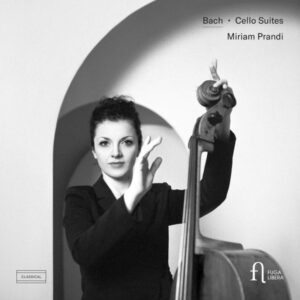
Miriam Prandi, Bach Cello Suites. Fuga Libera FUG 858 available on CD and digital download. Auditioned on Tidal streaming at 24bit/96Hz.
Recording venue. Academia Montis Regalis, Italy.
Date of recording 2ist to 26th August 2023.
Recording and mixing Maximilien Ciup.
Produced by Miriam Prandi.
Miriam plays a Cello by Giovanni Grancino of 1712. Metal strings and modern bow.
The Cellist.
Miriam Prandi is an exciting emergent Italian cellist, who graduated with a soloist diploma from the Hochschule der Kunste Bern in 2011, no doubt at a very young age. Her teachers include Antonio Meneses and more recently Natalia Gutman. Whilst this recording of the Bach Suites is her first solo recording release, her performance of the Dvorak cello concerto has drawn praise from critics and she has performed in various chamber groups over the last 10 years.
The CD booklet can be accessed on the Fuga Libera web site:
You will have to create an account and perform a simple arithmetic calculation to access the file!
I would judge the additional insight worth the trouble. There is also background to the recording including the rationale for use of a modern set up
The Recording.
In terms of sound quality, I judge this to be an excellent recording with an incisive, bold sound. No doubt the metal strings help but the soundstage is broad, and the dynamics are well captured, emphasising the many varied voices and contrasts that Prandi uses. At no stage in initial listening did extraneous noises intrude so probably one that Mark and other like-minded listeners will tolerate!
The Music
During listening to Prandi, I cannot help but constantly reference the recording by Kobekina. This is as much to draw out similarities as differences. Both are very reflective at times, clearly with a lot of attention to detail of phrasing. There is no reasonable criticism that can be made technically. The difference to my mind and this is a very subjective view is that Prandi is very intuitive in her approach. She plays with assertiveness and boldness when appropriate. I was left impressed by Kobekina’s intellectual dissection of the Suites but not wholly convinced or stirred! In contrast Prandi’s performance draws me in and is seductive. This free-flowing approach is hinted at in the accompanying notes. I suspect during live performances, the interpretation might vary from one occasion to the next. The other strong positive for me is that whilst there is a lot of liberty taken with speed and dynamics, the overall pulse and shape of each movement is preserved.
The total recording time is quite long at 2 hours 28 min, but time never seems to drag, even in the later Allemandes!
In general, the Sarabandes are on the slow side but not heavy or thick sounding. The Courantes and Gigues are rhythmic, lively and light.
Some detail
However, a major disappointment for me is that Prandi does not seem to bring the polyphonic nature of the music into focus. This seems particularly so in the third Suite Prelude. Whilst the cross-string passages are neatly executed she does not seem to emphasise the separate lines in the bass during the first half and in the upper registers in the second half.
To my mind, the fourth Prelude has more variations to its interpretation than most of the other five. For example, both in tempo and phrasing ranging from Maisky’s big boot heavy approach to Isang Ender’s sprint. Here, Prandi brings an interesting variant in that the emphasis for much of the movement seems to be on the top note of each quaver group as opposed to the bottom bass pedal E flat. At times it sounds as though the top note is actually the first note of each bar as opposed to the second note. I find it rather pleasing. In the fourth Courante something similar happens where in quaver passages, the descending notes are picked out so clearly that they sound on the beat rather than off the beat.
The fifth Sarabande is played with not a whiff of vibrato, very smooth, even and bleak in character. One of the best I have heard.
The sixth Prelude is dispatched with great aplomb and with no apparent technical challenges. The sound is clean and strong throughout. Very exciting!
I was expecting similar things from the sixth Courante but in this movement Prandi takes her time in places and gives a more considered approach than many who go full pelt at this movement. Similarly, in the final Gigue, I would have preferred a more purposeful approach.
Conclusion.
In summary a very impressive first release for this upcoming Italian cellist who I feel sure will be increasingly successful, as all the necessary ingredients appear to be present. Just a few subjective niggles prevent this being an unreserved recommendation. Still a very worthwhile recording to explore.
Charles.